

Not My First Rodeo
Twice I was accused of a serious crime I did not commit — both times on nothing but a theory and coincidence. The first accusation, at fifteen, taught my body exactly what to do when accused. Eighteen months later, an LAPD homicide detective watched it perform on cue — and read the performance as guilt.
Twice in my life I was accused of a serious crime I did not commit. Both cases were built the same way: a theory, a coincidence, and no evidence at all. The first, in the spring of 1981, cost me every friend I had. The second, on March 10, 1983, cost me twenty-six years.
Eighteen months sat between them. They were not two separate misfortunes. The first one rigged the second.
A false accusation is not an event you survive and walk away from clean. It is a program that gets installed in the body. Run it once — the throat closing, the mouth going dry, the eyes dropping — and it waits, fully loaded, to run again the instant the next accusation enters the room. Here is the cruel part, the part that sends innocent people to prison: the program looks exactly like guilt.
Follow the dates — but read them in two layers. Some of what they show, I lived through knowing. The rest I would not learn for forty years, until a confession finally arrived and rearranged the whole picture. At the time, I knew none of it.
The MechanismWhy the First One Rigs the Second
Two sociologists explained the machinery long before it ran me over. In 1902, Charles Horton Cooley called the self a looking-glass: we come to see ourselves in the mirror other people hold.1 Sixty years later, Erving Goffman traced what happens when that mirror marks you as one who doesn't quite belong — the kid who's a little different, a little apart, no longer counted as wholly one of the group — and how you come to carry that as a spoiled identity, whether or not you believe the verdict yourself.2
The Body Files the Verdict on Its Own
Identity isn't generated from the inside. It's installed from the outside. When the people around you treat you as a thief, your nervous system starts organizing itself around the idea that you are one. You don't have to accept it consciously. You don't even have to have done anything. The body files the verdict and adapts.
So eighteen months later, when a homicide detective leans across a table and tells you that you're a liar — that you've always been one — your body doesn't flinch in surprise. It recognizes the diagnosis. It has been preparing for the appointment.
Cooley (1902) · Goffman (1963)Accusation OneThe Driveway, Spring 1981
Money, a quarter pound of marijuana, and two Rush concert tickets vanished from the bedroom of my best friend — I'll call him Allen.3 The tickets were for the band's Moving Pictures show at The Forum on June 11, 1981.4 No witnesses. No suspects. For weeks the crowd I ran with circled the mystery and came up empty.
Then someone remembered a detail. Weeks before, the whole crowd had made a run to McDonald's and I'd stayed behind on the couch, half-asleep in front of the TV — the one stretch anyone could name when a single person had been alone in the house. That was it. That was the entire case. An opportunity, slowly rebranded as evidence.
And it was the wrong opportunity. I hadn't taken anything; I hadn't so much as thought of it. Allen was my best friend — a thousand hours logged in his garage, years of it going back to fishing off the Santa Monica Pier. I would not have stolen from him in any lifetime.
Let me be clear about the boy in that driveway, though: he was no choirboy bound for college with a spotless past. I was a pothead and a happy experimenter — and this was long before anyone called weed harmless, or legal. Back then, to love the high was to sign your name, knowingly, to a measure of lawlessness. My mother's generation didn't grade it on a curve; to them, marijuana sat on the same shelf as heroin — the first step on a foreordained march to foiled ambition, to trouble with the law, to a life spent in and out of jails and prisons. So when I say I was innocent, I don't mean spotless. I mean that the lawlessness I'd taken on lived in a different universe from betraying a friend — and a different universe again from what I would be accused of next. But the frame was already built. To the people holding the mirror, a boy who loved getting stoned was already halfway to a thief.
What I did do, a few days later, was sell one of my own two Rush tickets to a kid at school. I'd bought the pair hoping to find the nerve to ask out a girl named Lyla. I never found it, and I sold the spare to be rid of the reminder. The sale got back to Allen's sister — and the math snapped shut around me. Alone in the house. Sold a ticket. To sixteen-year-olds running on suspicion and witch-hunt fervor, that was a verdict.
I rode to Allen's house after school the way I had a thousand times before. Their faces were set hard.
“We know it was you.”
It wasn't a question. There was no inquiry, no chance to answer. They had deliberated like jurors and come to the driveway to read the verdict. I tried to speak, and my throat closed around the words. The denials came out thin, breathless, useless — and the harder I pushed them, the guiltier I looked. This is the first thing the body learns: the more clearly an innocent person sees that he isn't believed, the less able he becomes to sound like someone worth believing. The performance fails — and the failure looks like guilt.
The next day my father, a lawyer, walked me back. Allen's father — Miles Schumer, an attorney himself and an old friend of my dad's — offered to investigate. His investigation was to sit me on Allen's bed, alone, stare into my eyes like a polygraph he'd decided to become, and ask, in a quiet, level voice: Bruce, did you steal Allen's stuff? I said no. It was the truth. And the body did again, in close-up, what it had done in the driveway — the throat closing, the mouth drying, the eyes straining not to drop. He read the signs. He weighed them. He did not believe me.
Perhaps nothing affects a life more drastically than the quiet, confident certainty of those who have already decided.
The verdict stood. The crowd closed ranks. I was done.
The CloakThe Eighteen Months That Followed
In the months after the driveway I became a quieter version of myself. I never lost my own memory of that afternoon — the internal record stayed intact. What eroded was the faith that it would ever matter: that if I were doubted again in something serious, my account would be believed. That faith, once gone, does not come back. Goffman chose the word spoiled on purpose. Damage can be repaired. Spoilage is what happens to food. It does not reverse.
On February 21, 1982 — eight months after the driveway — I went to a Grateful Dead concert at UCLA's Pauley Pavilion. Outside, by sheer chance, I crossed paths with two former friends from the old crowd. It was a random collision in a crowd of thousands; none of us had planned it. The look they gave me wasn't surprise. It was the practiced glare of people who'd been told that someone they'd known was now to be treated as toxic. I dropped my eyes. I felt the cloak settle heavier around my neck.
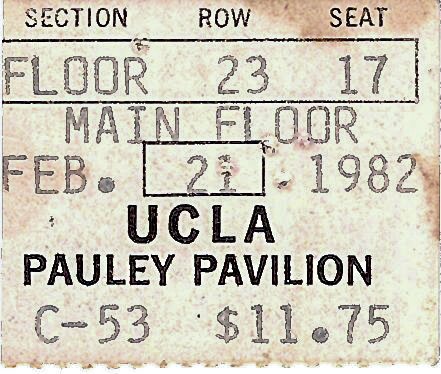
Here is what I would not learn for decades: the burglary had been the work of two boys from the wider circle. The one who went inside — I'll call him Darren — was, on the night of that glare outside the Dead concert, living in a fraternity house 1,500 feet from where I stood and shrank. His lookout I'll call Brad. The truth was a five-minute walk away the entire time. I just couldn't reach it.
The Body RemembersWhat the Nervous System Files
Repeated often enough, an accusation becomes a rehearsal. The body learns its part — in the small theater of the throat, the mouth, the muscles of the face — and it learns it involuntarily. I can name exactly what mine learned to do in those eighteen months:
mid-word
Every one of these is an ordinary response to fear. None is a sign of lying. And all four are routinely read — by people certain they can spot a liar — as lying. The body performs distress; the accuser scores it as guilt; the guilt licenses more pressure; the pressure produces more distress. That is the loop. And once the body has run it, it doesn't unlearn it. It becomes a pre-loaded program that fires, the same way, every time an accusation enters the room — each firing answering not just the present fear but the memory of the first one. The fear layers. The performance gets denser.
Accusation TwoThe Interrogation, March 10, 1983
By that morning I had been a marked boy for eighteen months — and I had quietly stopped expecting to be believed in anything serious. If people who'd known me my whole adolescence could decide I'd robbed Allen, anyone could decide anything.
That morning I came home and found my mother dying on our entry hall floor. Within hours, the LAPD homicide detective on the case — Andrew Monsue, a former Marine with what one reporter later called a “gruff military bearing” — had decided I'd killed her. Not from the evidence, despite what he later swore. From what the literature now calls a presumption of guilt: a verdict reached in the first hour, against which every later fact would be measured.5
I sat in an interrogation room at Van Nuys, seventeen years old, my mother mortally wounded five miles away. Monsue leaned across the table and told me — in the calm cadence of a man who already knew where the conversation ended — that I was a liar. Not just about my mother. A liar in general. A liar who had always been one. He wasn't describing a crime. He was telling me who I was, and inviting me to confess to the identity as the road to confessing the deed. (I have the transcripts — I pored over them for years building the Lisker Case Analysis6 — and I have made myself listen to the audio. Each time, it is a meeting with a shattered seventeen-year-old who has paid enough.)
The body recognized the diagnosis. The throat closed. The mouth dried. The words stalled mid-syllable. Across the table, Monsue watched the routine perform itself and read it — exactly as Allen had in the driveway eighteen months before — as proof. What no one in that room could have known is that this was the very sentence my nervous system had been braced to hear since the spring of 1981. It did not surprise me. It confirmed me — and it dropped into a groove already cut: the long-haired pot smoker my mother's generation had filed, in advance, under future convict. Monsue's verdict didn't introduce that idea. It only said out loud what the frame had been whispering for years. What rose up to meet it was not outrage and a clean defense of the truth, but the old body-memory from Allen's driveway: the cloak going heavy, the throat closing, the practiced certainty that whatever I said next would not be heard.
An Architecture That RepeatsThe Same Judgment, One Generation Up
The habit of deciding early wasn't only the kids'. Two years after he played polygraph on his son's bed, Miles Schumer took to ducking my father in the halls of the Van Nuys courthouse — looking away when he saw him coming — while my dad carried the worst burden a man can: his wife murdered, his only son jailed for it. The same family that named me a thief in 1981 on a theory and a coincidence couldn't face my father in 1983. The architecture of premature judgment wasn't a teenage thing. It was a family thing. The kids had learned it at home.
This is the second thing I want this essay to make clear: the people who decide about you prematurely in your adolescence are, very often, the same people whose own conduct under pressure will tell you, in retrospect, why they were able to decide about you the way they did. The capacity for premature judgment is a feature of certain people. It does not stop at one accusation. It does not stop at one generation. The garage crowd in 1981 used the same mental architecture as the homicide detective in 1983, and as the father in the courthouse hallway thereafter.
What the Research Now SaysThe Self-Fulfilling Interrogation
What Monsue did to me is now a published finding. In a landmark experiment, the psychologists Saul Kassin, Christine Goldstein, and Kenneth Savitsky told interrogators in advance that a suspect was probably guilty — or probably innocent — then turned them loose. Guilt and innocence were, in fact, assigned at random. Interrogators primed to expect guilt asked more accusatory questions, applied more pressure, and rated suspects as deceptive more often. The effect was strongest when the suspect was innocent.7
“Investigators armed with a prior expectation of guilt asked more guilt-presumptive questions, used more techniques designed to elicit a confession, exerted more pressure, and judged suspects as deceptive more often. The effect was most pronounced when their suspects were innocent.”
The presumption doesn't just color what the interrogator sees. It changes how he behaves — squeezing out of an innocent person the exact distress signals he'll then score as guilt. The suspect's nervous system writes the confession the interrogator already came to find. And training makes it worse: investigators schooled in the standard American technique judge truth and lies less accurately than untrained observers — while feeling far more certain.8 Training wasn't buying accuracy. It was buying confidence. The gap between the two is where innocent people go to prison.
Monsue reached his verdict before the evidence could speak, then spent the rest of the case confirming it. Seven weeks after my mother died, he sat down on tape with the man we now know killed her — and framed the man's choice as returning to California in custody or testifying against me. Every test the system ran on my guilt, it ran after the guilt had been decided. The instruments did not produce the verdict. The verdict produced the instruments.
Truth, Too LateThe Confession of 2021
In May 2021 — forty years after the driveway, twelve years after I walked out of prison — the confession finally came. It arrived over Facebook Messenger in the small hours from Brad, the lookout. He and Darren had done it. Darren went in; Brad sat out front in Darren's green custom pickup, watching for Allen's parents to return. But he got distracted and missed them entirely, honking only when it was already too late — and Darren bolted out the back, hopping fence after fence into the evening dusk.9
Then the detail that still takes my breath away: the next month, the two of them used Allen's stolen tickets to get into the concert — the Moving Pictures show at The Forum on June 11, 1981. Members of the old crowd were in that same arena that night, scanning the crowd for whoever had robbed him, pitchforks virtually at hand. The thieves were somewhere in the same building the whole time. No one ever found them.
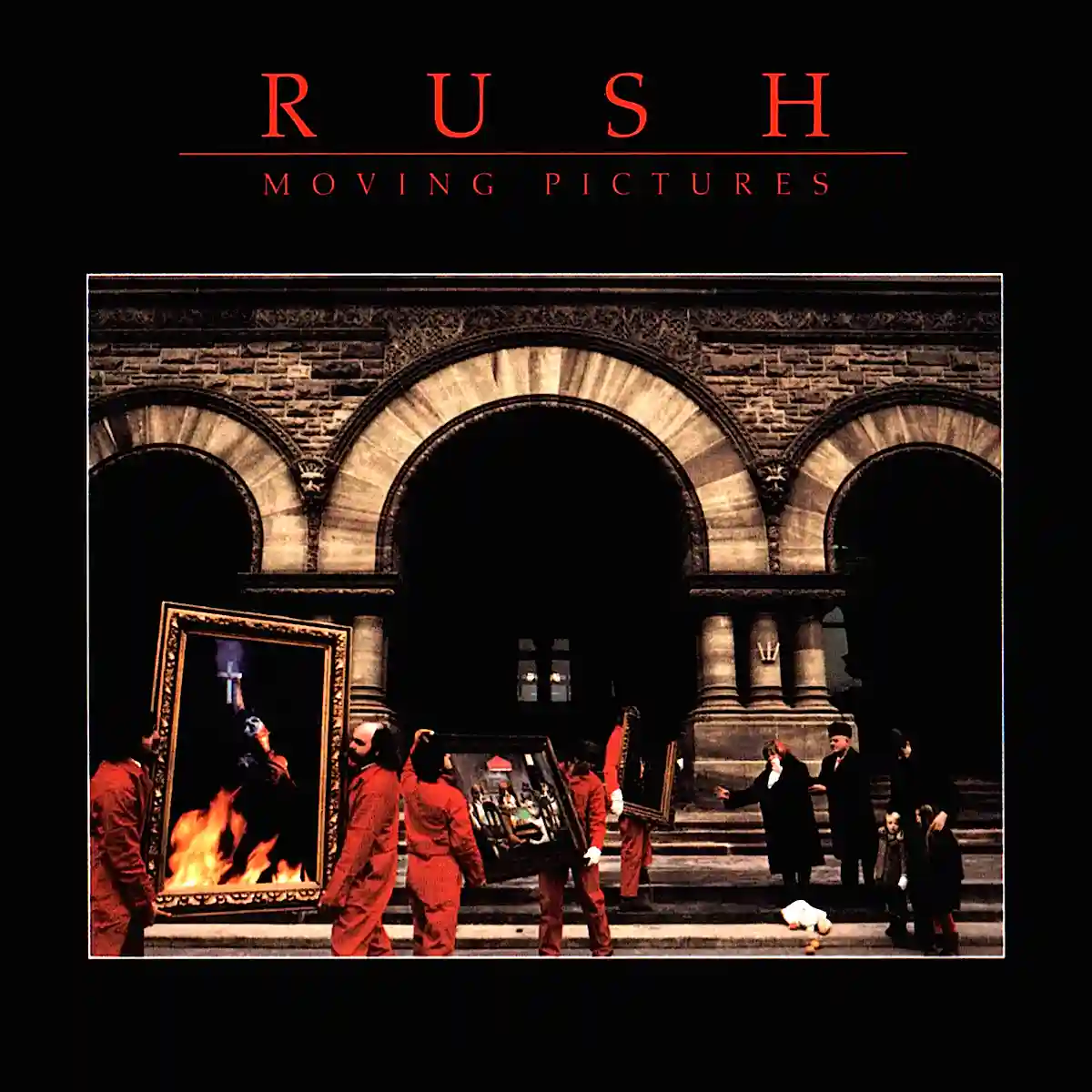
“Quiet in conscience, calm in their right
Confident their ways are best”
And there was a worse part — one that had nothing to do with the concert. Brad's 2021 message to me was not the first time he had told the truth. Years before it, long before he ever reached out to me, he had already confessed to Allen's sister. She had stood in the driveway in 1981 and named me a thief; for most of the years since, she had known I wasn't one. She said nothing. In 2010, she and Brad fought over exactly that — her refusal to clear my name — and it ended their lifelong friendship.
Allen never learned any of it. He died in December 2010, fourteen months after I came home, of the congenital heart condition that had shadowed him his whole life. He went to his grave believing his best friend had robbed him and lied straight to his face. He never got the truth. And I never got my name back from him.
“I was sucked into that crime, but that individual act could have put your life into the trajectory it went.”
By the time Monsue delivered his diagnosis in 1983, I'd been carrying the certainty that people I trusted would not believe me for eighteen months. By the time I walked out the gate in 2009, for twenty-eight years. By the time Brad's message arrived in 2021, for forty.
Cause and EffectThe Road the First Lie Built
There is one more turn to this, and it is the hardest thing I have ever had to set down.
After the banishment, my parents — seizing on the opportunity to, as they saw it, replace my pot-smoking friends with sober ones — enrolled me in the Palmer Drug Abuse Program. It was meant to save me. Instead, it walked me straight into the man who would one day destroy our family. I met him there, in PDAP. His name was Mike Ryan.
Mike Ryan murdered my mother.10
Follow that backward, and it does not come apart. Had Allen's family not decided, on a theory and a coincidence, that I was a thief, my parents would have had no reason to place me in that program. Had I never entered the program, I would never have met Ryan. Had I never met Ryan, he would not have been inside our house on the morning of March 10, 1983. The first false accusation did not merely prime my body to fail the second one. It built the road that delivered my mother's killer to our door. A lie told by teenagers in a driveway is the first link in the chain that ended her life.
And yet.
In those same years, an older man I'll call Vince Capretti kept putting drugs in front of me — the harder kind, the kind that moved by needle. And in those very years, riding unseen in those shared needles, was something no one could yet name: an unidentified virus that, in the seasons just ahead, would quietly take kids I knew — and go on to kill nearly a million gay men and intravenous drug users before the world had so much as a word for it. Within two years of my arrest, Vince Capretti himself contracted HIV, and then AIDS. The man who kept handing me the needle was already, unknowingly, carrying what rode inside it.
I was, as I've admitted, a willing experimenter, and the road I was on had one likely destination. When the LAPD framed me and a jury sent me away, the cell took twenty-six years from me. It also took me off the streets, away from Capretti, away from the needles. I say this with no drama and no gratitude, as a plain and terrible fact: had I not been framed for my mother's murder, I would very probably be dead.
Two lies sit at the root of my life. The first one led, link by link, to my mother's murder. The second one — the one that cost me everything — is most likely the only reason I survived to write this.
CodaThe Truth Was Always Within Walking Distance
Both times, the truth sat close enough to touch.
In 1982, the exact spot outside Pauley Pavilion where I dropped my eyes under that glare was 1,500 feet — five minutes on foot — from the fraternity house where Darren, the boy who had actually robbed Allen, was living as an undergraduate. I had been exiled by my own community on a theory and a coincidence, and the one who really did it was sleeping, or studying, or smoking on a porch, a few hundred yards away.
Eighteen months later it was true again. Mike Ryan had undoubtedly just left our house when I knocked at the front door and heard the thump inside. Seven weeks after that, Monsue sat Ryan down on tape, caught him in three documented lies inside a single hour — and let him walk back into the world a free man, free to harm others, while I served his sentence.
This is what the architecture of premature judgment does. It sets the truth within walking distance of the people who could have gone and learned it — and then arranges, out of cowardice or conviction or the sheer comfort of a decision already made, for the walk never to be taken.
A false accusation is not an event. It is an installation. Mine was installed twice — once in a driveway, once in an interrogation room — and the second time, my body already knew its lines. It had been rehearsing for eighteen months.
1 Charles Horton Cooley, Human Nature and the Social Order (New York: Charles Scribner's Sons, 1902), Chapter V: “The Social Self.” The three-step formulation of the looking-glass self — the imagination of one's appearance to another, the imagination of the other's judgment of that appearance, and the resulting self-feeling — is set out there in Cooley's own words. ↩
2 Erving Goffman, Stigma: Notes on the Management of Spoiled Identity (Englewood Cliffs, NJ: Prentice-Hall, 1963). The concepts of spoiled identity and the moral career of the stigmatized person are central to the book and have, in the sixty years since, become the conceptual foundation of the sociological study of labeling and deviance. ↩
3 In keeping with this series' policy of withholding the names of private individuals who are not material to the public record, the names “Allen,” “Stacy,” “Lyla,” “Darren,” “Brad,” and “Vince Capretti” in this essay are pseudonyms. The events described are reported as I lived them and as they were later confirmed to me by one of the participants. The names that are not pseudonymous are those material to the public record of the case — Det. Andrew Monsue and Michael Ryan. ↩
4 Rush, Moving Pictures tour, The Forum, Inglewood, California, June 11, 1981. Confirmed via the tour's archived setlist record. The band played The Forum two consecutive nights that week; the ticket I sold was for the June 11 show. ↩
5 The phrase presumption of guilt, as used in modern psychological literature on police interrogations, is most closely associated with the work of Saul M. Kassin, whose foundational studies on guilt-presumptive interrogation are cited below. See The Psychology of Confessions, Kassin & Gudjonsson, Psychological Science in the Public Interest, 5(2), 2004; and the field-defining review “Police-Induced Confessions: Risk Factors and Recommendations,” Kassin et al., Law and Human Behavior, 34(1), 2010 (updated 2025). ↩
6 The Lisker Case Analysis is the three-volume, exhaustive review of my case that I assembled during my incarceration. Volume One, at 105 pages, is the analysis itself — the evidence and testimony presented, the police theories, the contradictions found in those theories, and alternate suspects and scenarios never previously presented. Volume Two contains over 700 footnote references substantiating every claim and analysis in Volume One. Volume Three is the documentary archive — copies of the actual reports, handwritten notes, and diagrams. I have described the LCA as my magnum opus; its construction consumed all the free time and energy I had inside. ↩
7 Saul M. Kassin, Christine C. Goldstein & Kenneth Savitsky, “Behavioral Confirmation in the Interrogation Room: On the Dangers of Presuming Guilt,” Law and Human Behavior, 27(2), 2003. ↩
8 Saul M. Kassin & Christina T. Fong, “‘I'm Innocent!’: Effects of Training on Judgments of Truth and Deception in the Interrogation Room,” Law and Human Behavior, 23(5), 1999. Subsequent replications — including with practicing police investigators — have produced consistent findings. ↩
9 The account of Brad and Darren's conduct in 1981 throughout this essay — the burglary of Allen's bedroom, their attendance at the June 11, 1981 Rush concert using Allen's stolen tickets, Brad's confession to Stacy in the years that followed, and the 2010 fight that ended their lifelong friendship — was related to me by Brad himself in a series of Facebook Messenger messages on April 29–30, 2021. I have not corroborated these accounts through court records; I include them as the personal account he gave me. The verbatim quote reproduced in the Truth, Too Late section is from his message timestamped April 30, 2021, 3:06 a.m. ↩
10 The identification of Michael Ryan as my mother's killer is set out in detail in the Lisker Case Analysis and rests on evidence developed during the post-conviction proceedings that led to the 2009 federal reversal of my conviction. The case against Ryan was also laid out at length in the Los Angeles Times' investigative reporting on my wrongful conviction — see Scott Glover, “New Light on a Distant Verdict,” Los Angeles Times, May 22, 2005 — which examined the evidence pointing to him in considerable detail. The case is further summarized in the public sources linked at the foot of this essay. ↩
This essay is part of the Portrait of a Frame-Up series. The wrongful conviction in this case was overturned by the United States District Court for the Central District of California in 2009. The series can be read in full at brucelisker.com/essays-portrait.